Web Design for Professional Services UK: What Most Firms Get Wrong
Accountants, solicitors, consultants, and financial advisors all share the same web design problem: their sites look credible but generate almost no new business. Here is what needs to change.
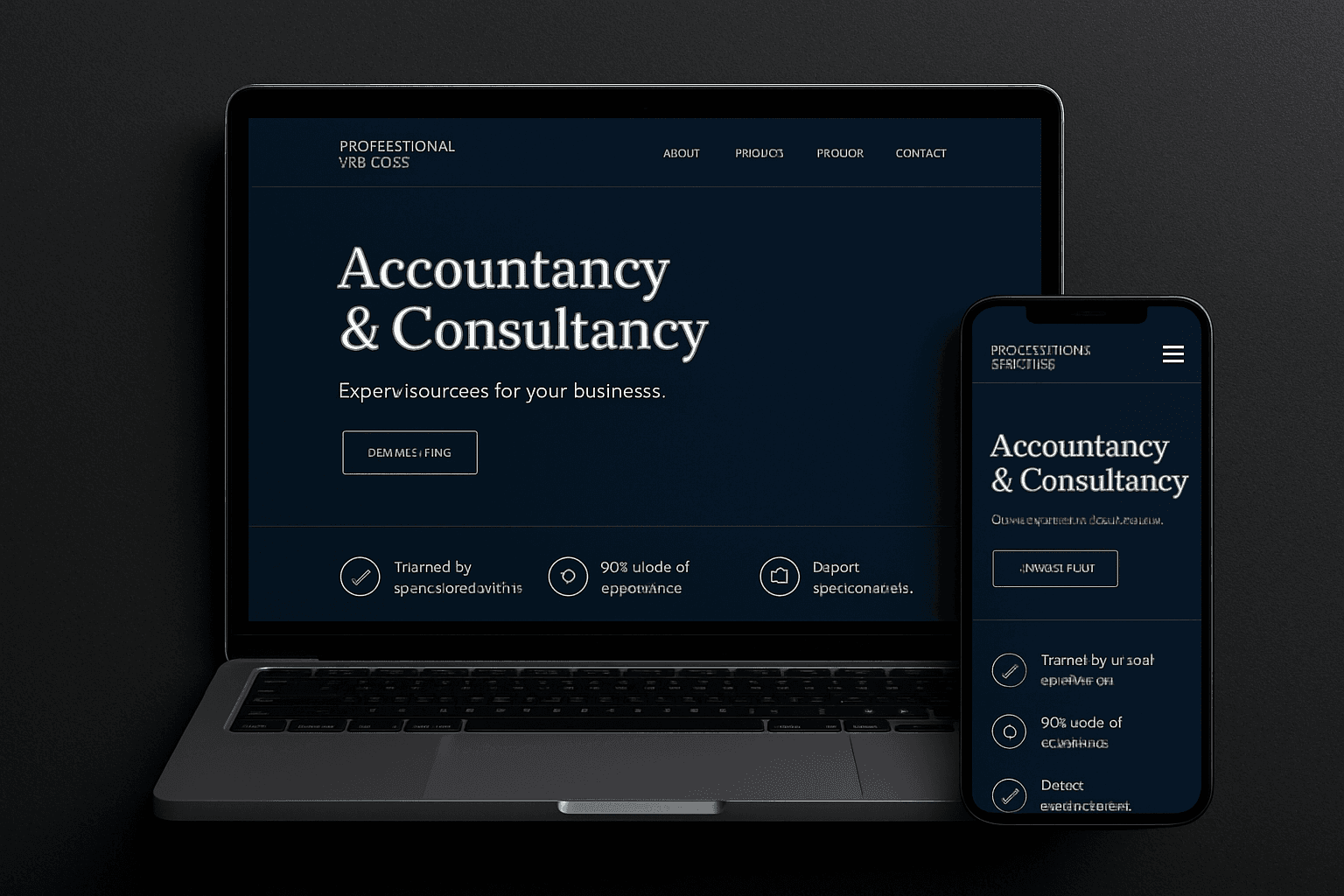
The Professional Services Website Problem
Walk through the websites of most UK accountancy firms, law practices, consultancies, and financial advisors and you will find the same things. Conservative colour palettes. Stock photography of suited figures shaking hands. Navigation menus with headings like "Our Services," "Our Team," and "Contact Us." And almost no indication of who, specifically, the firm serves well.
These sites exist to pass a basic credibility test: if a prospect types the firm name into Google and a professional website appears, the box is ticked. What they rarely do is generate new business. They are not designed to. They are designed to avoid embarrassment.
That is a missed opportunity. In a competitive professional services market, it is also becoming a costly one.
Why Trust Is the Real Conversion Problem
Professional services firms operate in a high-trust category. The stakes for a client choosing an accountant, solicitor, or management consultant are significant. The wrong choice means financial risk, legal exposure, or wasted time and budget. Buying decisions are careful and slow.
Your website needs to work with that reality.
The instinct in professional services design is to signal trustworthiness through visual conservatism: muted colours, formal language, credentials listed in the footer. These elements provide a baseline of credibility. But they do not answer the questions a serious prospect is actually asking when they land on your site:
- Have you handled situations like mine before?
- What results have you delivered for clients in my position?
- Who specifically would I be working with at this firm?
- What makes you different from the three other firms I am also evaluating?
Generic professional services websites do not answer these questions. They describe services in abstract terms, list credentials without context, and bury contact information as if enquiries were an inconvenience rather than the point.
What Converts in Professional Services
The professional services sites that actually generate enquiries share a consistent set of design and content decisions.
Specificity over breadth. A solicitor positioned as "we handle all areas of law" loses to one who says "we specialise in property disputes and commercial lease negotiations for growing SMEs." Specificity signals expertise. It also pre-qualifies visitors, which means the enquiries that do come in are better quality and closer to ready to buy.
Case results over credentials. A list of qualifications tells a prospect you are competent. A case study that says "we helped a mid-sized logistics company reduce its annual tax liability by 34% through a group restructure" tells them you are effective. Credentials are necessary but not sufficient. Results are what close.
Named professionals with real bios. Clients hire people, not firms. A photo and a genuine biography create a human connection that a firm overview page never achieves. The lead partner or senior consultant should have a page that reads like they wrote it, not like it was approved by a compliance committee.
Clear, visible next steps. Professional services websites consistently bury their contact options. A phone number in the footer in a small font is not an invitation. A visible "Book a free 30-minute call" button in the header, repeated at the bottom of every service page, makes the path to conversion obvious.
The SEO Gap Most Firms Ignore
Here is the compounding problem with the standard professional services website: it does not rank for anything useful.
Most professional services sites have no blog, no content beyond static service pages, and no local SEO optimisation. They rely almost entirely on direct traffic and referrals. That works until referral networks slow down or a competitor with a content strategy starts taking their search positions.
Organic search traffic in professional services is exceptionally valuable because intent is so high. Someone searching "commercial solicitor Manchester" or "accountant for contractors UK" is actively looking to hire. A firm that appears at the top of those results, with a website that clearly speaks to that specific need, will win that business over the firm appearing lower with a generic homepage.
Content strategy for professional services does not need to be complicated. Practical guides, case-study articles, FAQ pages built around common client questions, and locally optimised service pages together create a foundation that compounds over time. The firms investing in this now are the ones dominating search results in their niche by 2027.
Mobile Performance Is Not Optional
There is a persistent assumption in professional services that serious buyers are on desktop. The data does not support it. In the UK, mobile traffic accounts for more than 60% of browsing across all professional categories, including B2B services.
A partner considering switching accountants is still browsing on their phone during a commute or between meetings. If your site is difficult to read or navigate on mobile, you lose that consideration before they have finished the first page.
This is partly a design issue and partly a performance issue. A mobile experience that loads in under two seconds, with clearly readable text and a thumb-friendly contact button, will outperform a desktop-first site every time.
What the Best Professional Services Sites Have in Common
The pattern across well-converting professional services websites is consistent:
- A clear, specific opening statement about who they serve and what outcome they deliver
- Visible social proof near the top of the page, with names and specific results rather than vague endorsements
- Named team members with genuine bios and direct contact options
- Service pages optimised for specific search terms, with practical and useful content
- A fast, mobile-first build with intuitive navigation
- One clear action the visitor should take, repeated at logical points throughout the page
None of this is radical. But most professional services firms in the UK have none of it working together.
The Referral-to-Search Transition
A significant number of UK professional services firms built their client base almost entirely through referrals. That model has served them well. It is also increasingly fragile.
Referral networks narrow as industries consolidate. Younger decision-makers default to search rather than asking colleagues for a recommendation. The firms that make the transition from referral-dependent to search-visible now are the ones that will grow through the next decade. Those that wait will find the gap harder to close.
Your website is the infrastructure that transition runs on.
How TsvWeb Approaches Professional Services Web Design
We design for the conversion goal, not the approval committee. That means clear positioning, trust signals placed where they do the most work, and a content structure built to rank for the searches your best prospects are making.
We work with UK professional services businesses on a flat-rate subscription basis. One monthly fee covers ongoing design and development. No separate project costs, no agency retainers that grow beyond what was agreed.
If your website is not generating the enquiries your referral network used to, or if you are trying to grow beyond word-of-mouth, let us take a look at what you have and what it would take to make it work.